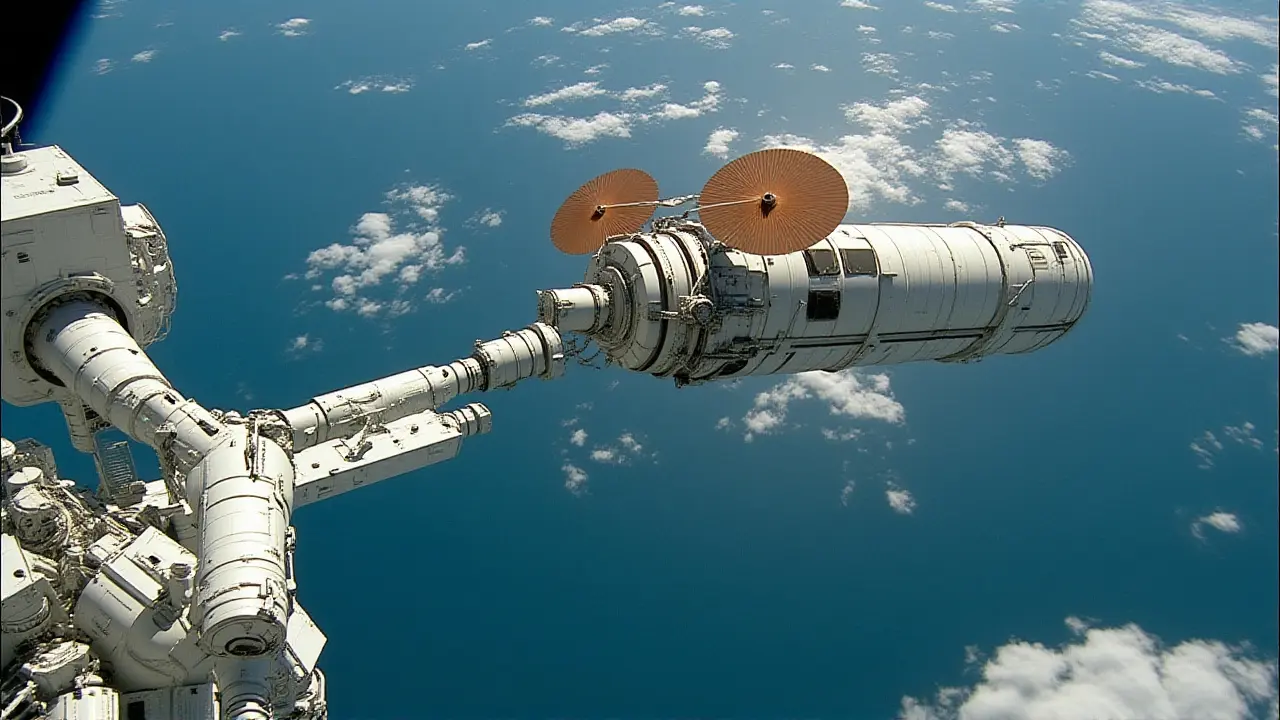
A massive delivery of scientific gear and essential supplies has officially arrived at the orbiting laboratory. On April 13, 2026, the 24th NASA-contracted resupply mission, CRS-24International Space Station, successfully rendezvoused with the seven-person crew of the International Space Station (ISS). This isn't just a routine grocery run; the mission brought roughly 11,000 pounds of critical cargo designed to push the boundaries of quantum physics and medicine.
Here's the thing: this mission marks a significant step in cargo capacity. The spacecraft used for this trip is the Cygnus XL, a beefed-up version of the standard solar-powered craft. It launched a couple of days prior, on April 11, 2026, at 7:41 a.m. EDT, riding atop a SpaceX Falcon 9 rocket from Cape Canaveral Space Force Station in Florida. Turns out, the partnership between the launch provider and the spacecraft manufacturer is becoming the backbone of low-Earth orbit logistics.
- Cargo Weight: Approximately 11,000 pounds of supplies and research.
- Launch Vehicle: SpaceX Falcon 9.
- Spacecraft: Cygnus XL (S.S. Steven R. Nagel).
- Arrival Date: April 13, 2026.
- Primary Goal: Support Expedition 74/75 research and station maintenance.
The Logistics of a Space Delivery
Getting a cargo ship to a station moving at 17,500 miles per hour isn't as simple as parking a car. After the Cygnus XL reached the vicinity of the ISS, astronauts used the 57-foot Canadarm2 robotic arm to snag the vehicle. Ground controllers then guided the process of berthing the craft to the Earth-facing port of the Unity module.
Almost immediately after the connection was secured, Zena Cardman, a NASA astronaut, was spotted inside the Unity module. She was already diving into the cargo, unpacking new hardware while the rest of the crew prepared for the influx of supplies. (It's a bit like the feeling of a fresh shipment arriving at a remote outpost—exciting and a bit chaotic.)
Science That Could Change Everything
While the food and spare parts are great for morale and maintenance, the real gold is in the science experiments. The CRS-24 mission is carrying a specialized module to advance quantum science. Why does this matter? This research could lead to computing technology that makes today's supercomputers look like calculators and might even help scientists finally track down dark matter.
But the impact isn't just theoretical. The mission includes hardware designed to produce a higher volume of therapeutic stem cells. This could lead to breakthroughs in treating blood diseases and various cancers right here on Earth. Additionally, the crew will be working with model organisms to study the gut microbiome—essentially figuring out how the bacteria in our stomachs react to microgravity.
There's also a practical side to the tech. A new receiver is on board to enhance space weather models. By better understanding solar winds and radiation, agencies can protect critical infrastructure like GPS and radar systems from being fried by a solar storm.
A Legacy of Orbital Support
This mission isn't an isolated event but part of a long-term partnership. Northrop Grumman has been a key player in ISS logistics since 2013. Over the last decade, they've hauled more than 158,000 pounds of essential gear to the station. The Cygnus XL variant itself is still relatively new; its first flight, the NG-23, took place on September 14, 2025, proving that the larger design could safely deliver the same 11,000-pound payload.
Interestingly, the spacecraft for this mission was named the S.S. Steven R. Nagel. It's a tribute to a former NASA astronaut who spent over 720 hours in space across four shuttle missions. It's a nice touch that reminds us that while the tech is automated, the mission is built on human courage.
What Happens Next?
For now, the Cygnus XL is essentially a storage locker for the crew. It's scheduled to remain docked until October 2026. But the end of the journey is where things get dramatic. Unlike the SpaceX Dragon, which returns to Earth with samples, the Cygnus is an expendable craft.
Before it departs, the crew will load it with several thousand pounds of trash and waste. Once it detaches, the ship will plunge back into the atmosphere and burn up completely. It's the ultimate cosmic garbage disposal service, ensuring the station stays clean and habitable.
On the day of arrival, the ISS looked more like a crowded parking lot than a laboratory. Five different ships were docked simultaneously: the SpaceX Crew-12 Dragon, the Cygnus XL, a Russian Soyuz MS-28, and two Progress resupply ships (93 and 94). This congestion highlights just how dependent the station is on a constant stream of international logistics to keep the lights on and the science moving.
Frequently Asked Questions
What makes the Cygnus XL different from the standard Cygnus?
The Cygnus XL is a larger, more cargo-capable version of the solar-powered spacecraft developed by Northrop Grumman. It is designed to maximize the payload capacity, allowing it to carry upwards of 11,000 pounds of scientific equipment and supplies in a single trip, which increases the efficiency of resupply missions to the ISS.
How does the Cygnus spacecraft help with waste management?
Unlike some return vehicles, Cygnus is expendable. Before it leaves the station, astronauts fill it with several thousand pounds of trash and obsolete equipment. When it departs, it performs a controlled destructive reentry, burning up in Earth's atmosphere and effectively disposing of the station's waste.
What are the main scientific goals of the CRS-24 mission?
The mission focuses on several high-impact areas: advancing quantum science for better computing and dark matter research, producing therapeutic stem cells to fight cancer and blood diseases, studying the gut microbiome using model organisms, and improving space weather models to protect GPS and radar infrastructure.
When will the Cygnus XL leave the International Space Station?
The spacecraft is scheduled to remain attached to the Unity module's Earth-facing port until October 2026. After providing storage and support for several months, it will be loaded with waste and sent back to Earth for its final destructive reentry.

Gary Clement
April 16, 2026 AT 18:04really cool to see the synergy between the falcon 9 and cygnus xl it basically streamlines the whole l-earth orbit supply chain
Dianna Knight
April 16, 2026 AT 21:07Total game changer for the LEO ecosystem! 🚀 The delta-v efficiency and payload capacity on this beast are just top-tier. It's like a massive win for the orbital logistics pipeline! ✨
Antony Bachtiar
April 18, 2026 AT 15:30pfft who cares about a few more lbs of gear it's basically just a fancy trash can that burns up anyway total waste of tax payer money lol
Aaron X
April 20, 2026 AT 15:14The intersection of quantum coherence and microgravity environments represents a profound ontological shift in how we perceive information processing. By leveraging the lack of gravitational decoherence, we are essentially probing the very fabric of spacetime to refine our understanding of dark matter's influence on baryonic structures. It is a transcendental leap from classical computing toward a truly non-local paradigm of calculation.
Shelley Brinkley
April 21, 2026 AT 01:13probly just some overpriced lab gear thatll break in a week anyway lol a total mess
Beth Elwood
April 22, 2026 AT 07:35The stem cell research is actually the most important part here 🧬 Producing them in microgravity allows for better 3D structural growth compared to the flat plates we use on Earth 🌍 This could seriously revolutionize how we treat leukemia and other blood disorders 💉
Josh Raine
April 22, 2026 AT 10:28Why do we keep dumping everything into the atmosphere and calling it "disposal"? It's just polluting the upper atmosphere with vaporized metal and chemicals! 🙄 We act like the vacuum of space is a magic eraser but we're just pushing the problem into the thermosphere! This is just lazy engineering masked as "convenience"!
nikolai kingsley
April 23, 2026 AT 02:08typical gov waste just throwing stuff up there to feel good about thmselves while people on earth starve lol
priyanka rajapurkar
April 23, 2026 AT 04:38Oh sure, because sending a giant metal box to carry our trash into a fireball is just so incredibly sustainable. Truly the peak of human innovation right here.
Mason Interactive
April 25, 2026 AT 02:20The naming of the S.S. Steven R. Nagel is a great touch. It keeps the human element alive in an era where everything is becoming fully autonomous.
Mel Alm
April 25, 2026 AT 23:52the canadarm2 is so cool i love how it just grabs things in space
Angie Khupe
April 26, 2026 AT 23:29It's so wonderful to see different countries and companies working together like this! 😊 Such a beautiful example of what we can achieve as a species <3
Alex Green international
April 27, 2026 AT 09:55The logistical coordination required to manage five simultaneous dockings is quite impressive. One must appreciate the precision of the ground controllers in ensuring the safety of the crew and the station